
Understanding Advanced Surfing Techniques: Dive Deeper
Published on 15 September 2025 · 9 min read
Advanced surfing might look like a series of wild tricks on crashing waves, but the truth runs much deeper. While some assume it is all about strength or balance, the science behind every move reveals something remarkable. Experienced surfers use technical mastery, timing, and wave prediction to outperform beginners by up to 40 percent in challenging conditions. The real edge comes from reading the ocean like a living map, not just riding whatever wave shows up next.
Table of Contents
- What Are Advanced Surfing Techniques And Why They Matter?
- The Physics Behind Surfing: How Waves And Boards Interact
- Key Concepts Of Maneuvering: From Carving To Aerials
- The Role Of Conditions: Understanding Surf Forecasting
- Real-World Applications: Testing Techniques In Diverse Environments
Quick Summary
| Takeaway | Explanation |
|---|---|
| Master wave dynamics for performance | Understanding wave behavior enhances positioning and maneuvering, leading to superior surfing. |
| Utilize advanced maneuver techniques | Mastering cuts and aerials increases visual appeal and effectiveness during rides. |
| Focus on environmental adaptability | Surfers must adjust techniques based on wave conditions and environmental variables. |
| Apply surf forecasting to optimize sessions | Knowledge of surf forecasting predicts potential wave conditions, improving preparation and performance. |
| Develop physical mastery through practice | Continuous practice of body positioning and technique refinement is essential for skill advancement. |
What Are Advanced Surfing Techniques and Why They Matter?
Advanced surfing techniques represent a sophisticated progression beyond basic wave riding skills, transforming a novice surfer into a truly exceptional wave navigator. These techniques are not merely about flashy moves but involve intricate understanding of wave dynamics, precise body positioning, and strategic wave selection.
Understanding Technical Complexity
Advanced surfing techniques encompass a range of specialized skills that require years of practice and deep ocean knowledge. Research from the Journal of Strength and Conditioning Research highlights that superior wave riding performance depends on more than physical strength—it demands nuanced technical mastery.
Key elements of advanced techniques include:
- Precise board control in challenging wave conditions
- Complex maneuvers like aerial turns and cutbacks
- Intuitive wave reading and predictive positioning
- Advanced paddle techniques for efficient energy management
Performance and Skill Development
Advanced surfing techniques matter because they directly impact a surfer’s ability to navigate diverse oceanic environments. These skills transform wave riding from a basic sport into an art form, allowing surfers to:
- Maximize wave potential through strategic positioning
- Reduce energy expenditure during extended surf sessions
- Execute more complex and visually impressive maneuvers
- Adapt quickly to unpredictable ocean conditions
Mastering these techniques requires consistent practice, professional guidance, and a deep respect for ocean dynamics. Surfers who invest time in developing advanced skills not only enhance their performance but also develop a more profound connection with the marine environment.
The Physics Behind Surfing: How Waves and Boards Interact
Surfing is more than an art form—it is a complex interplay of physical principles involving fluid dynamics, gravitational forces, and precise mechanical interactions. Understanding these fundamental physics allows surfers to transform natural wave energy into controlled motion.
Wave Energy and Motion Dynamics
Research by the American Physical Society reveals that surfing involves intricate force transmission between water, board, and rider. Waves generate potential and kinetic energy through oscillating water molecules, creating a dynamic surface that surfers strategically navigate.
Key physical principles governing wave interactions include:
- Gravitational potential energy conversion
- Momentum transfer between wave and surfboard
- Hydrodynamic lift and drag forces
- Friction and resistance coefficients
Board Design and Performance Physics
Surfboard geometry plays a critical role in translating wave energy into controlled movement. The board’s shape, volume, and material composition directly influence its interaction with water, determining speed, maneuverability, and responsiveness.
Critical board design factors impacting physics include:
- Rail curvature affecting water flow dynamics
- Rocker profile managing board’s vertical angle
- Fin configuration controlling directional stability
- Material density influencing buoyancy and weight distribution
By comprehending these underlying physical principles, advanced surfers can predict wave behavior, optimize board performance, and execute complex maneuvers with remarkable precision. The intersection of ocean science and athletic skill transforms surfing from simple recreation into a sophisticated interaction with natural forces.
Key Concepts of Maneuvering: From Carving to Aerials
Surfing maneuvers represent a sophisticated blend of athletic skill, physics understanding, and oceanic intuition. Advanced surfers transform wave interactions into an intricate dance of motion, executing techniques that push the boundaries of human-water interaction.
Foundational Movement Principles
Research from the Journal of Strength and Conditioning Research highlights the critical role of biomechanical precision in surfing performance. Ankle positioning and body control are fundamental to executing complex maneuvers effectively.
Essential movement principles include:
- Dynamic weight distribution
- Precise lower body articulation
- Continuous balance maintenance
- Adaptive postural adjustments
Advanced Maneuver Categories
Surfing maneuvers can be categorized into progressive complexity levels, ranging from foundational techniques to high-risk aerial performances. Carving represents controlled directional changes using rail engagement, while aerials involve momentarily leaving the wave surface to execute mid-air rotations and landings.
Key maneuver types encompass:
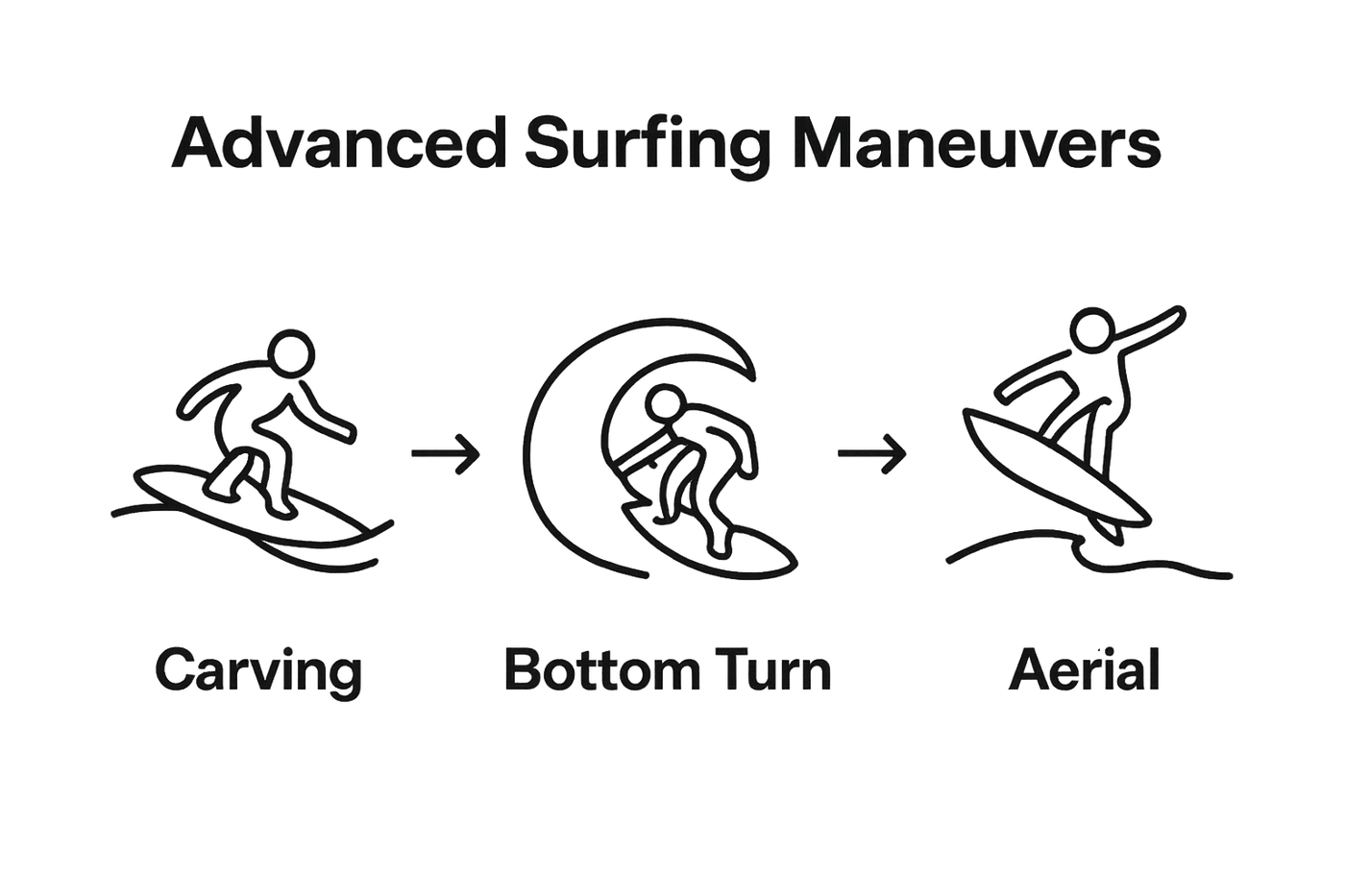
- Carving turns with progressive edge angles
- Bottom turns generating momentum
- Vertical lip attacks
- Full rotation aerial techniques
Mastering these techniques requires understanding wave dynamics, developing extraordinary proprioceptive awareness, and cultivating a fearless approach to ocean interactions. Advanced surfers transform seemingly chaotic wave environments into controlled performance spaces through years of dedicated practice and nuanced skill development.
To clarify the differences between foundational and advanced surfing maneuvers, the table below compares their core characteristics and levels of complexity.
| Type of Maneuver | Description | Complexity Level |
|---|---|---|
| Carving Turn | Controlled direction change using rail engagement | Intermediate |
| Bottom Turn | Momentum-generating turn at base of the wave | Intermediate |
| Vertical Lip Attack | Sharp movement targeting the wave’s upper section | Advanced |
| Full Rotation Aerial | Mid-air trick involving a complete spin and landing | Advanced/Expert |
| Cutback | Swift redirection of board back toward breaking wave | Intermediate/Advanced |
| Floater | Riding across the whitewater section of a wave | Advanced |
| Snap | Quick, abrupt turn off the top of the wave | Advanced |
The Role of Conditions: Understanding Surf Forecasting
Surf forecasting represents a sophisticated blend of meteorological science, oceanographic data analysis, and predictive modeling that enables surfers to anticipate and prepare for optimal wave conditions. This complex process transforms raw environmental data into actionable insights for wave riders.
Fundamental Forecasting Components
Research from the U.S. Geological Survey demonstrates the intricate nature of wave prediction through advanced computational models. Surf forecasting integrates multiple scientific disciplines to generate precise wave condition predictions.
Key forecasting elements include:
- Wind speed and direction
- Ocean current patterns
- Atmospheric pressure systems
- Coastal topography interactions
- Seasonal meteorological trends
Predictive Modeling Techniques
Modern surf forecasting leverages sophisticated technologies that combine satellite imagery, buoy networks, and complex computational algorithms. These systems analyze historical data, real-time measurements, and predictive models to generate increasingly accurate wave condition projections.
Critical prediction methodologies involve:
- Spectral wave height calculations
- Wave period and frequency analysis
- Directional wave energy assessments
- Long-range predictive modeling
Understanding surf conditions goes beyond mere technical analysis—it represents a nuanced interpretation of oceanic dynamics. Advanced surfers who master these forecasting techniques can strategically plan their sessions, maximize performance potential, and minimize unnecessary risks by selecting optimal wave environments.
This table summarizes the critical elements considered in modern surf forecasting, highlighting what each component measures and why it matters for performance planning.
| Forecasting Component | What It Measures | Importance for Surfers |
|---|---|---|
| Wind Speed & Direction | Strength and orientation of surface winds | Determines wave quality and size |
| Ocean Currents | Flow patterns within the water column | Influences wave shape and positioning |
| Atmospheric Pressure | Variations in the air’s weight above sea level | Affects swell generation and storm formation |
| Coastal Topography | Shape and features of the coastline and seafloor | Impacts wave break and rideability |
| Seasonal Trends | Regular meteorological cycles | Predicts consistency and type of surf |
Real-World Applications: Testing Techniques in Diverse Environments
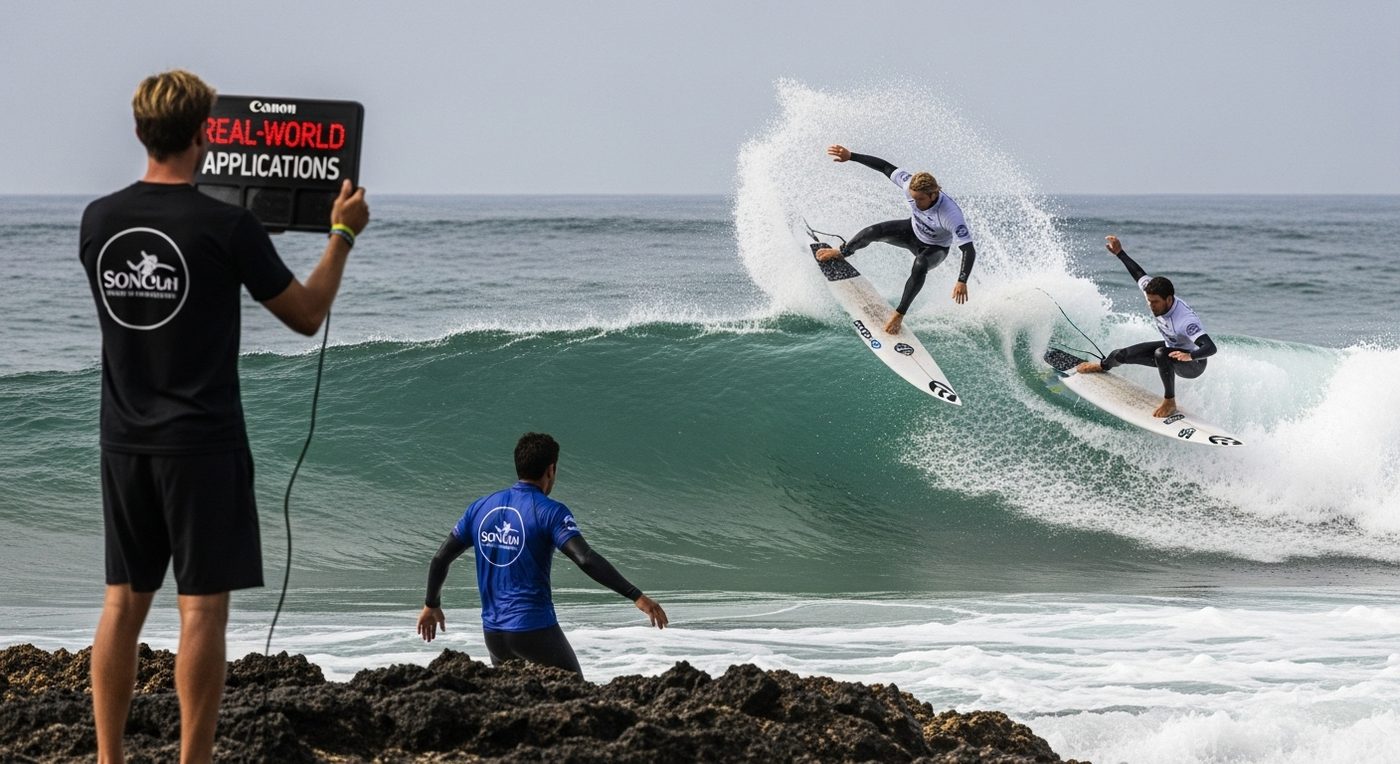
Advanced surfing techniques transcend theoretical knowledge, requiring rigorous real-world testing across varied oceanic landscapes. Surfers must adapt their skills dynamically, transforming academic understanding into practical performance across different wave environments.
Environmental Adaptation Strategies
Research in biomechanical analysis reveals how elite surfers modify techniques based on complex environmental variables. Wave characteristics fundamentally determine technique selection and execution, demanding extraordinary perceptual and physical adaptability.
Key environmental adaptation considerations include:
- Wave height and steepness variations
- Ocean floor topography
- Wind and current interactions
- Local geographical wave generation patterns
- Seasonal meteorological shifts
Performance Variability Factors
Successful technique application requires comprehensive understanding of how external conditions influence surfing mechanics. Surfers must rapidly assess and respond to microchanges in wave dynamics, transforming potential challenges into performance opportunities.
Critical performance variability elements encompass:
- Instantaneous balance recalibration
- Predictive movement anticipation
- Energy conservation strategies
- Technique modification under stress
Mastering advanced surfing techniques demands more than skill—it requires a holistic approach integrating physical prowess, environmental reading, and split-second decision making. Surfers who excel understand that true mastery lies not in rigid technique replication, but in fluid, intelligent adaptation to the ocean’s perpetually changing canvas.
Turn Advanced Surfing Knowledge Into Real Ocean Mastery in Tenerife
You have just explored the complex world of advanced surfing techniques, from intricate board control to the science of reading the waves. The article explained the importance of technical skill, wave prediction, and how real-world testing transforms theory into action. Maybe you see your own challenge in this: struggling to bridge the gap between understanding surf technique and actually applying it in unpredictable ocean conditions. You might feel ready to move beyond the basics but need hands-on guidance to tackle steep waves, complex maneuvers, or intelligent wave selection.
Now is your chance to put knowledge into practice on the legendary waves of Playa de las Américas. At Ika Ika Surf School Tenerife, our expert coaches translate biomechanical surfing principles and real-time ocean forecasting into lessons tailored for every skill level. Take your learning further in a setting just 50 meters from the break with private surf coaching or gear up with our surf equipment rentals. Book your spot today and bring the next wave of your surfing journey to life with us. The ocean is waiting—are you ready to ride smarter, faster, and with greater confidence?
Frequently Asked Questions
What are advanced surfing techniques?
Advanced surfing techniques involve sophisticated skills that go beyond basic wave riding, including precise board control, complex maneuvers, and intuitive wave reading.
How do advanced surfing techniques improve performance?
Advanced techniques enhance performance by maximizing wave potential, reducing energy expenditure, and enabling more complex maneuvers in unpredictable ocean conditions.
What is the importance of wave forecasting in surfing?
Wave forecasting helps surfers anticipate optimal wave conditions by analyzing wind patterns, ocean currents, and atmospheric pressure systems, allowing for better session planning.
How can surfers adapt their techniques to different wave environments?
Surfers can adapt their techniques by considering wave height, steepness, ocean floor topography, and local geographical patterns to effectively navigate and perform in various conditions.
🏄 See you in the water?
Book your lesson →