
How to Stand Up on a Surfboard: A Beginner’s Guide
Published on 10 September 2025 · 13 min read
Standing up on a surfboard looks simple when you watch seasoned surfers on the beach. Yet beginners are shocked to learn that even with the right board, more than 60 percent still struggle just to pop up and ride their first wave. The surprising part is that it is not about brute strength or athletic background. Most new surfers fail because of simple mistakes in equipment choice and body position and with a few small changes, anyone can catch that magic first ride sooner than they thought.
Table of Contents
- Step 1: Choose The Right Surfboard And Equipment
- Step 2: Practice Paddling In The Water
- Step 3: Position Your Body Correctly On The Surfboard
- Step 4: Execute The Pop-Up Technique Effectively
- Step 5: Balance And Ride The Wave
Quick Summary
| Key Point | Explanation |
|---|---|
| 1. Choose a soft-top surfboard | For beginners, an 8-9 feet soft-top surfboard provides stability and safety during learning. |
| 2. Master paddling technique | Practice paddling in calm water to develop muscle memory, focusing on body position and efficient strokes. |
| 3. Perfect your pop-up motion | Execute the pop-up as a fluid, quick motion to transition from paddling to standing effectively. |
| 4. Maintain a balanced stance | Keep knees bent and weight evenly distributed while riding waves to enhance stability and control. |
| 5. Embrace falls as learning experiences | Falling is a natural part of surfing; each wipeout offers lessons for future improvement on the board. |
Step 1: Choose the Right Surfboard and Equipment
Learning how to stand up on a surfboard starts with selecting the right equipment. Your success as a beginner surfer depends significantly on choosing a surfboard that matches your skill level, body type, and learning objectives. Surfboard selection is more than just picking a random board – it requires understanding your physical capabilities and the board’s characteristics.
For novice surfers, soft-top surfboards represent the ideal starting point. These boards provide exceptional stability, forgiveness, and safety during your initial learning stages. According to Australian Broadcasting Corporation, soft-top boards around 8-9 feet long offer superior balance and make the process of standing up much easier for beginners.
When evaluating surfboards, consider these critical factors: board length, width, thickness, and volume. Longer and wider boards provide more stability, which is crucial when you’re learning fundamental techniques like paddling and standing up. Beginners should aim for boards that are approximately 2-3 feet taller than their height, ensuring enough buoyancy and surface area to support learning.
Equipment beyond the surfboard also plays a significant role in your surfing experience. A proper wetsuit, leash, and surf wax are essential components that contribute to your comfort and safety. Choose a wetsuit appropriate for the water temperature where you’ll be surfing. A well-fitted leash prevents your board from drifting away after a fall, while surf wax provides the necessary grip on your board’s surface.
Consider renting equipment initially to experiment with different board types and sizes before making a significant investment. Many surf schools, including Ika Ika Surf School Tenerife, offer rental options that allow beginners to test various surfboards under professional guidance.
Key equipment checklist for beginners:
- Soft-top surfboard (8-9 feet recommended)
- Wetsuit matching water temperature
- Surfboard leash
- Surf wax
- Rash guard (optional but recommended)
Remember that your first surfboard is a learning tool, not a performance instrument. Focus on comfort, stability, and gradual skill development rather than purchasing the most expensive or advanced board available. With the right equipment and mindset, you’ll be well-prepared to take your first steps towards becoming a confident surfer.
Step 2: Practice Paddling in the Water
Paddling is the fundamental skill that connects you to the ocean and sets the foundation for successfully standing up on a surfboard. Before attempting to ride waves, you must develop a strong, efficient paddling technique that builds muscle memory and confidence. Mastering paddling is more than just moving your arms through water – it requires understanding body positioning, rhythm, and energy conservation.
According to academic research on surfing technique, developing proper paddle mechanics directly impacts overall surfing performance. Begin by practicing in calm, shallow water where you can touch the bottom and feel secure. Place your surfboard in water deep enough to float comfortably but not so deep that you cannot maintain control.
Position yourself on the surfboard by lying centered, with your body balanced from nose to tail. Your chest should rest slightly forward of the board’s midpoint, allowing optimal weight distribution and maneuverability. Your legs should be together and slightly raised, helping to stabilize your position. Cup your hands and extend your arms into the water, alternating side-to-side strokes with smooth, powerful movements.
Focus on maintaining a streamlined body position during paddling. Your head should remain relatively still, with your gaze directed forward or slightly down. This reduces drag and helps conserve energy. Each paddle stroke should be deliberate and strong, pulling water smoothly alongside the board’s rail. Avoid splashing or creating unnecessary turbulence – efficient paddling is about clean, consistent motion.
Key paddling technique verification points:
- Smooth, alternating arm movements
- Centered body position on the board
- Minimal upper body movement
- Consistent stroke rhythm
- Controlled breathing
Practice paddling in progressively challenging conditions as you build confidence. Start in calm waters, then gradually move to areas with gentle waves. Ika Ika Surf School Tenerife recommends dedicating significant time to paddling practice before attempting to stand, as this skill forms the critical foundation of surfing.
Remember that muscle fatigue is normal during initial practice. Take breaks, stay hydrated, and listen to your body. Paddling requires developing specific muscle groups that might feel unfamiliar at first. Consistent practice will transform initial awkwardness into smooth, natural movement, preparing you for the exciting moment of standing up on your surfboard.
Below is a checklist table to help you verify your paddling technique as described in the guide. Review each item to ensure you are practicing correctly.
| Technique Checkpoint | Description |
|---|---|
| Smooth, alternating arm movements | Use left and right arms in a rhythmic pattern without splashing |
| Centered body position on the board | Lie so your weight is balanced nose to tail along the board |
| Minimal upper body movement | Keep head and torso steady while paddling |
| Consistent stroke rhythm | Maintain steady, strong strokes with each arm |
| Controlled breathing | Breathe regularly to conserve energy and avoid fatigue |
Step 3: Position Your Body Correctly on the Surfboard
Positioning your body correctly on the surfboard is a critical skill that determines your success in standing up and maintaining balance. Proper body alignment transforms your relationship with the wave, converting potential instability into smooth, controlled motion. Think of your body as a dynamic instrument that communicates with the surfboard through precise, intentional movements.
According to SurfSpots.org research, achieving the ideal surfing stance requires strategic weight distribution and body positioning. Begin by lying centered on the surfboard, with your chest slightly forward of the board’s midpoint. This positioning allows maximum control and facilitates easier transition when preparing to stand.
While lying on the board, focus on creating a stable base. Your hands should be positioned slightly wider than shoulder-width apart, placed flat on the board’s surface near your chest. Keep your arms strong but relaxed, ready to push your body upward during the critical pop-up moment. Your toes should remain pointed, helping to maintain body alignment and providing additional stability.
As you prepare to stand, practice the pop-up motion on land first. This technique involves a swift, explosive movement that transforms you from a prone position to a standing stance. Start by placing your hands flat on the board, slightly ahead of your shoulders. In one smooth motion, push your upper body upward while simultaneously bringing your front foot forward and between your hands. Your back foot will follow, landing near the board’s tail, creating a stable, shoulder-width stance.
Body positioning verification checklist:
- Chest centered on surfboard
- Hands placed shoulder-width apart
- Smooth, controlled pop-up motion
- Feet positioned for balanced stance
- Knees slightly bent
- Weight distributed evenly
Practice this movement repeatedly on solid ground to build muscle memory. Ika Ika Surf School Tenerife recommends dedicating significant time to perfecting the pop-up technique before entering water. Understanding the mechanics of body positioning helps reduce anxiety and increases confidence when actually catching waves.
Remember that every surfer’s body is unique, and finding your perfect stance takes time and practice. Be patient with yourself, stay focused on technique, and embrace the learning process. Your body will gradually develop the intuitive understanding needed to move seamlessly between paddling and standing on your surfboard.
Step 4: Execute the Pop-Up Technique Effectively
The pop-up technique represents the most critical moment in learning how to stand up on a surfboard. This explosive movement transforms you from a prone paddling position to a balanced standing stance in a single, swift motion. Mastering the pop-up requires precision, strength, and muscle memory that develops through consistent practice and proper technique.
According to research in the Journal of Sports Science & Medicine, executing an effective pop-up demands rapid upper body strength, core engagement, and coordinated lower limb movement. Begin by positioning yourself on the board exactly as practiced during previous land-based training. As a wave approaches, paddle with increasing intensity to match the wave’s speed, then prepare for the critical transition.
The pop-up is a single, fluid motion that happens in less than a second. As you feel the wave lifting your board, place your hands flat on the board, slightly wider than shoulder-width apart. Your hands should be positioned near your chest, with elbows close to your body. In one explosive movement, push your upper body upward while simultaneously drawing your front foot forward and between your hands. This motion requires significant core strength and practice.
Common mistakes can derail your pop-up technique. Many beginners move too slowly or hesitate during the transition, which causes loss of momentum and balance. Practice the movement as a quick, decisive action – imagine your body is a spring being rapidly released. Your back foot should follow immediately after your front foot, landing near the board’s tail. Aim to land in a stable, low stance with knees slightly bent and weight centered over the board.
Pop-up technique verification points:
- Rapid, single-motion transition
- Hands positioned shoulder-width apart
- Front foot lands between hands
- Back foot follows quickly
- Knees remain slightly bent
- Weight distributed evenly
Drill this technique repeatedly on land before attempting it in water.
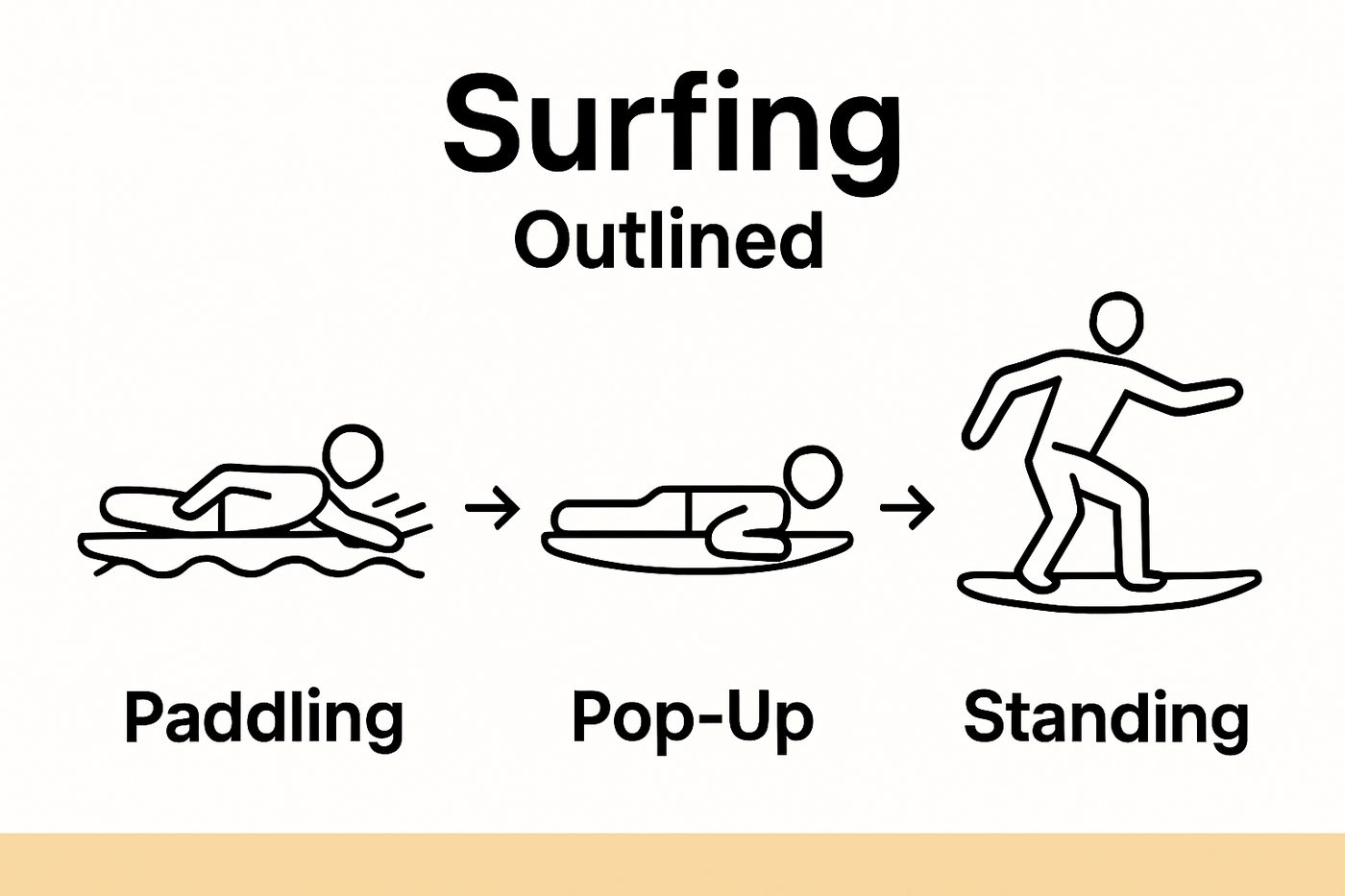 Ika Ika Surf School Tenerife recommends using a yoga mat or soft surface to practice the movement, focusing on speed and smoothness. Start slowly, breaking down each component, then gradually increase your speed until the motion feels natural and instinctive.
Remember that every surfer struggles with the pop-up initially. Patience and persistent practice are key. Your body will develop muscle memory over time, transforming an awkward, conscious effort into a smooth, automatic response.
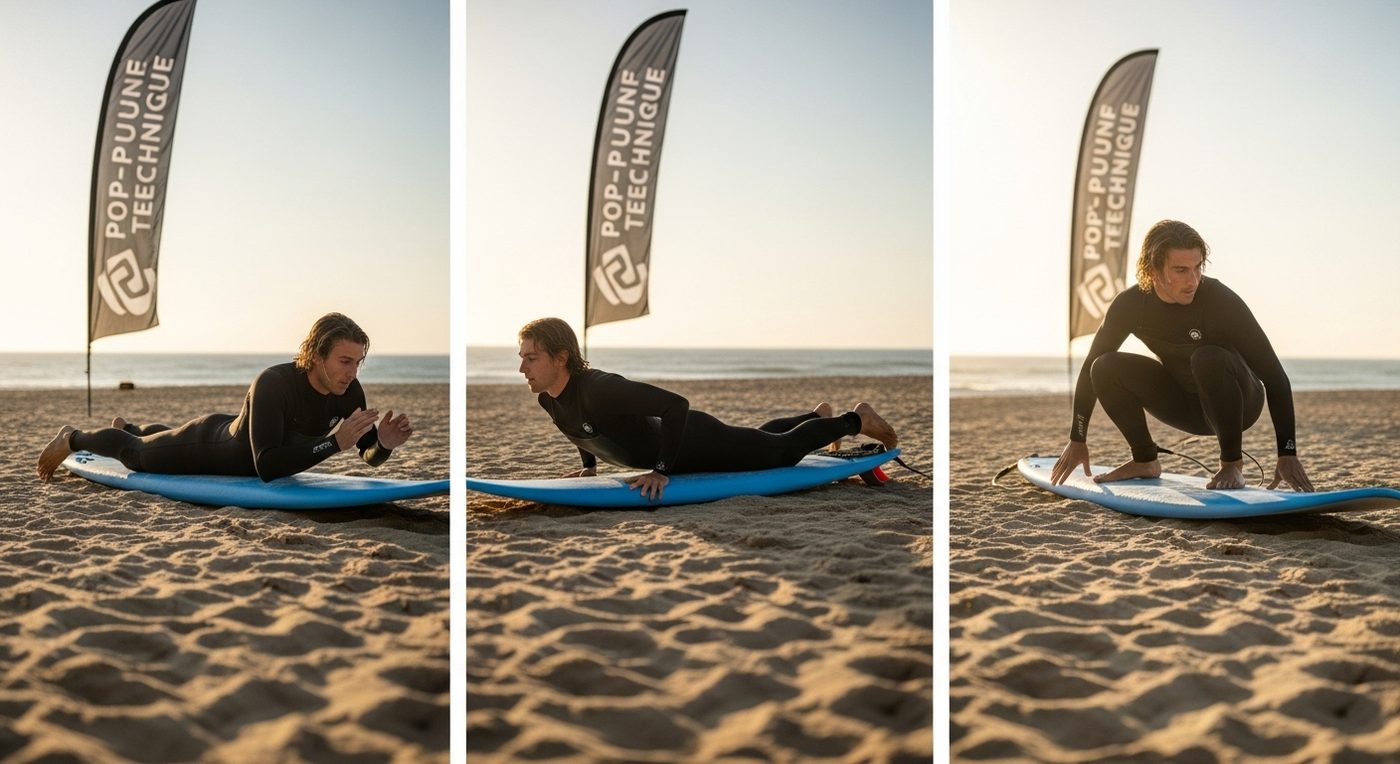 Embrace the learning process, stay positive, and celebrate each small improvement in your technique.
Step 5: Balance and Ride the Wave
Riding a wave represents the ultimate reward for your surfing practice, transforming all your previous efforts into a moment of pure exhilaration. Balance is the invisible force that connects you to the ocean’s energy, turning a potentially chaotic experience into a graceful dance between surfer and wave. Maintaining stability requires a combination of physical technique, mental focus, and intuitive body awareness.
According to MedlinePlus medical resources, balance and coordination are skills that can be systematically developed through focused training. Once you’ve successfully popped up on your surfboard, your primary goal is to maintain a low, stable stance. Keep your knees slightly bent, body centered, and weight distributed evenly across both feet. Your front foot should be positioned near the board’s center, while your back foot provides additional stability and control near the tail.
Initial wave riding demands constant micro-adjustments. Think of your body as a living suspension system, absorbing the wave’s movement through flexible joints and responsive muscles. Your arms play a crucial role in maintaining balance – keep them relaxed but ready to help you adjust. One arm slightly extended can help you maintain orientation, while the other remains closer to your body. Avoid rigid movements or sudden shifts that might disrupt your board’s delicate connection with the wave.
As you gain confidence, begin to explore subtle weight transfers that allow you to navigate the wave’s surface. Leaning slightly forward increases speed, while a gentle shift backward can slow your momentum. These nuanced movements require practice and develop an intuitive understanding of your board’s behavior. Start with small, controlled adjustments and gradually expand your range of motion as your comfort level increases.
Balance and wave riding verification checklist:
- Knees remain slightly bent
- Weight distributed evenly
- Arms relaxed and ready to adjust
- Minimal upper body movement
- Smooth, responsive stance
- Consistent board contact with wave
Ika Ika Surf School Tenerife recommends practicing balance techniques in various conditions. Begin in calm waters with gentle waves, progressively challenging yourself as your skills improve. Each wave offers a unique learning opportunity, teaching you about ocean dynamics, board control, and your own physical capabilities.
Remember that falling is an integral part of learning. Every experienced surfer has spent countless hours tumbling into the water, transforming each wipeout into a valuable lesson. Embrace these moments with humor and determination. Your journey to mastering wave riding is a continuous process of adaptation, practice, and incremental improvement.
Here is a troubleshooting table that highlights common difficulties beginners face when learning to stand up on a surfboard, along with likely causes and suggested solutions based on the guide.
| Problem | Likely Cause | Suggested Solution |
|---|---|---|
| Difficulty balancing | Incorrect stance or poor weight distribution | Keep knees bent, distribute weight evenly |
| Slow or hesitant pop-up | Lack of muscle memory or practicing too slowly | Practice quick, fluid land pop-ups |
| Falling off after standing | Stiff posture or rigid upper body | Stay relaxed, make micro-adjustments |
| Board drifting away | Not using a leash | Always attach a proper surf leash |
| Slipping off the board | No wax or insufficient grip | Apply surf wax before each session |
You’ve Learned the Steps—Now Experience the Real Waves in Tenerife
You now know the theory behind standing up on a surfboard. The next challenge is putting these essential skills into action on real waves with expert support. If you’ve struggled with paddling technique, pop-up timing, or balance on unfamiliar equipment, you are not alone. Many beginners experience frustration trying to transfer what they read into real-world surfing. High-quality instruction and the right environment speed up your progress and boost your confidence each step of the way.
Why wait and risk picking up bad habits or missing out on the joy of your first wave ride? At Ika Ika Surf School Tenerife, our professional instructors guide you through each skill, from proper board selection to mastering your pop-up. Enjoy safe, reliable equipment rentals, immediate access to the beach, and a supportive community that celebrates every milestone. Take your next step and book your first lesson or explore our equipment rental options. Start building real surfing skills in Tenerife today.
Frequently Asked Questions
What type of surfboard is best for beginners?
For beginners, a soft-top surfboard approximately 8-9 feet long is ideal. These boards provide stability, forgiveness, and safety during the initial learning stages, making it easier to stand up and balance.
How do I practice paddling effectively on a surfboard?
To practice paddling effectively, lie centered on the board with your chest slightly forward of the midpoint. Use smooth, powerful strokes while alternating arms and focus on body positioning to minimize drag. Start practicing in calm, shallow water for comfort and control.
What is the proper technique for standing up on a surfboard?
The proper technique, known as the pop-up, involves quickly pushing your upper body up while bringing your front foot forward between your hands, followed by your back foot landing near the tail of the board. This should be done in a single, fluid motion.
How can I improve my balance while riding a wave?
To improve balance while riding a wave, keep your knees slightly bent and your weight evenly distributed across both feet. Make micro-adjustments with your body and arms, maintaining a relaxed posture to adapt to the wave’s movements. Practice in various conditions to build confidence and skill.
🏄 See you in the water?
Book your lesson →