Understanding Surf Course Options for All Levels
Published on 1 October 2025 · 10 min read
Surf courses are everywhere, promising to turn beginners into wave riders and help seasoned surfers reach new heights. More than 80 percent of new surfers choose structured courses to skip the trial and error and fast-track their skills. Surprising, right? Many think just grabbing a board and paddling out is enough, but the most successful surfers credit their progress to following specific surf course pathways instead of going it alone.
Table of Contents
- What Are Surf Course Options And Why They Matter
- Different Levels Of Surf Courses Explained
- Types Of Surf Courses: Group Vs. Private Lessons
- What To Expect From Your Surf Course Experience
- Choosing The Right Surf Course For Your Goals
Quick Summary
| Takeaway | Explanation |
|---|---|
| Choose a surf course based on skill level. | Identify your current proficiency to select the right course—beginner, intermediate, or advanced. |
| Professional instruction enhances safety and learning. | Structured courses offer personalized feedback, ensuring safer and more effective skill development. |
| Group lessons foster social learning dynamics. | These lessons are cost-effective and encourage collaboration, making learning more enjoyable. |
| Private lessons provide tailored learning experiences. | One-on-one instruction allows for immediate feedback and rapid skill progression based on individual needs. |
| Prepare mentally and physically before lessons. | Arrive ready with proper swimwear and an open mindset, as preparation enhances the learning experience. |
What Are Surf Course Options and Why They Matter
Surf course options represent structured learning pathways designed to help individuals of all skill levels progress in surfing. These programs provide systematic approaches to understanding wave dynamics, mastering techniques, and building confidence on the water.
Understanding the Learning Landscape
Surf courses are not one-size-fits-all experiences. They are meticulously crafted educational programs that cater to different skill levels and personal objectives. Understanding surf skills for beginners reveals the complexity and nuance behind effective surfing instruction.
Key aspects of surf course options include:
- Beginner Courses: Foundational programs introducing basic water safety, board handling, and fundamental techniques
- Intermediate Courses: Advanced skill development focusing on wave reading, more complex maneuvers, and technique refinement
- Advanced Courses: Specialized training for experienced surfers targeting specific performance goals
The Importance of Professional Instruction
Professional surf instruction goes beyond simple technique teaching. According to Surfing Life Magazine, structured courses provide critical benefits that self-learning cannot replicate. These include personalized feedback, safety protocols, equipment understanding, and psychological preparation for challenging ocean environments.
Surf course options matter because they transform the learning experience from potentially dangerous trial-and-error attempts to structured, safe, and progressive skill development. By providing systematic learning approaches, these courses ensure that students not only learn surfing techniques but also develop a comprehensive understanding of ocean dynamics, personal capabilities, and surfing culture.
Different Levels of Surf Courses Explained
Surf courses are strategically designed to meet the diverse skill progression of surfers, ranging from absolute beginners to advanced wave riders. Understanding these distinct levels helps students choose the right learning pathway and set realistic expectations for their surfing journey.
Beginner Surf Course Fundamentals
What is a beginner surf class introduces newcomers to the essential foundations of surfing. These entry-level courses focus on critical skills that form the backbone of water safety and basic technique. Participants learn fundamental elements such as:
- Board positioning and balance techniques
- Ocean safety and wave reading basics
- Proper paddling and standing mechanics
- Understanding surf etiquette and environmental awareness
Progressive Learning Stages
Surf instruction follows a structured progression that systematically builds skills. According to International Surfing Association, effective surf education moves through carefully defined stages that challenge and support learners at each level.
Key progression stages include:
- Foundational Level: Initial water confidence and basic board control
- Intermediate Level: Wave catching techniques and more advanced maneuvers
- Advanced Level: Complex surfing skills and specialized performance training
Technical Skill Development
Each surf course level demands specific technical competencies. Advanced surfing techniques demonstrate how skills transform from basic survival techniques to sophisticated wave riding. Instructors assess individual capabilities and design personalized learning experiences that push students beyond their comfort zones while maintaining safety and enjoyment.
The goal of multi-level surf courses is not just teaching techniques but creating confident, competent, and passionate surfers who understand the ocean’s nuanced dynamics and their personal potential within it.
The following table summarizes the typical features and objectives at each major surf course level, helping you identify what to expect and where you might fit on your surfing journey.
| Course Level | Focus Areas | Skills Developed | Ideal For |
|---|---|---|---|
| Beginner | Safety, board handling, basic techniques | Paddling, standing, balance, wave reading | Absolute beginners and first-timers |
| Intermediate | Technique refinement, wave catching, maneuvers | Turning, wave selection, more advanced maneuvers | Surfers with basic skills aiming to improve |
| Advanced | Specialized performance, competition preparation | Complex maneuvers, performance analysis, big wave skills | Experienced surfers targeting advancement |
Types of Surf Courses: Group vs. Private Lessons
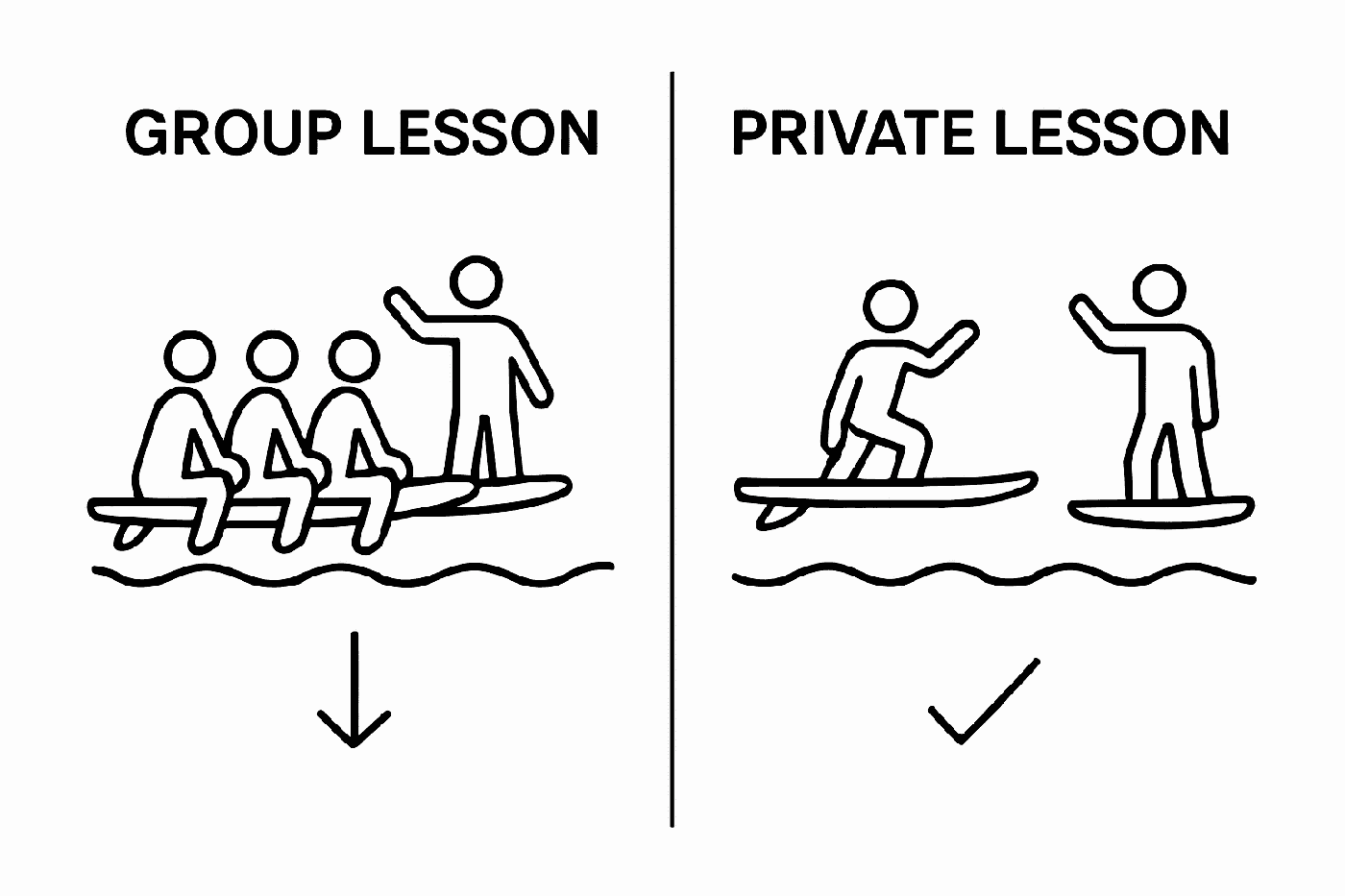
Surf courses represent flexible learning environments with distinct instructional approaches, designed to accommodate different learning styles, skill levels, and personal objectives. Understanding the nuanced differences between group and private lessons helps students make informed decisions about their surfing education.
Group Surf Lesson Dynamics
Group surf lesson guide reveals the collaborative and social learning experience inherent in group settings. These sessions provide collective learning opportunities where participants benefit from shared experiences and peer interactions.
Key advantages of group surf lessons include:
- Cost-effective training
- Social learning environment
- Opportunity for friendly competition
- Structured curriculum with standardized techniques
- Enhanced motivation through group dynamics
Private Lesson Personalization
According to Ocean Swim Safaris, private surf lessons offer unparalleled personalized attention that accelerates individual skill development. These one-on-one sessions allow instructors to craft highly customized learning experiences tailored to specific student needs.
Benefits of one-on-one surf lessons highlight the targeted approach of private instruction. Students receive immediate feedback, precise technique correction, and rapid skill progression in a focused learning environment.
Choosing the Right Lesson Type
Deciding between group and private surf courses depends on multiple factors:
- Personal learning preference
- Budget constraints
- Current skill level
- Specific performance goals
- Comfort with individual or group settings
Ultimately, both lesson types offer valuable pathways to surfing proficiency. The most effective approach involves understanding personal learning needs and selecting an instructional format that maximizes individual potential and enjoyment.
Below is a comparison table outlining the key differences between group surf lessons and private surf lessons, helping you evaluate which option best fits your learning style and goals.
| Lesson Type | Main Features | Advantages | Best For |
|---|---|---|---|
| Group Lessons | Multiple students per instructor | Social interaction, cost-effective | Beginners, social learners |
| Private Lessons | One-on-one instruction | Personalized feedback, rapid progression | Focused improvement seekers |
| Group Lessons | Standardized curriculum | Friendly competition, shared motivation | Those who enjoy community |
| Private Lessons | Customized lesson plan based on individual needs | Addresses specific weaknesses | Those with unique goals |
What to Expect from Your Surf Course Experience
Surf courses transform learning from a potentially intimidating challenge into an exciting, structured journey of skill development and ocean understanding. Each course represents a carefully designed pathway that guides students through progressive learning stages while ensuring safety, enjoyment, and personal growth.
Initial Preparation and Expectations
How to learn surfing naturally highlights the importance of mental and physical preparation before stepping onto the surfboard. Students should anticipate a holistic learning experience that goes beyond mere technical instruction.
Key preparatory elements include:
- Appropriate swimwear and sun protection
- Basic swimming competency
- Open mindset and willingness to learn
- Physical fitness appropriate to ocean activities
- Realistic expectations about skill progression
Learning Environment and Instructor Interaction
According to Surfing Magazine, the quality of instructor interaction significantly impacts a student’s surfing journey. Professional instructors create supportive environments that balance technical guidance with psychological encouragement.
Students can expect:
- Personalized feedback and technique correction
- Step-by-step skill breakdown
- Continuous safety monitoring
- Gradual complexity increase
- Emphasis on ocean awareness and respect
Progression and Personal Development
A comprehensive surf course transcends physical skill acquisition. It becomes a transformative experience that builds confidence, understanding of natural environments, and personal resilience. Instructors focus not just on wave riding techniques but on developing a holistic understanding of surfing as a physical and mental discipline.
The ultimate goal is creating confident, competent surfers who understand the intricate relationship between human movement and oceanic dynamics, ensuring a lifelong connection with the marine environment.
Choosing the Right Surf Course for Your Goals
Selecting an appropriate surf course requires careful consideration of personal objectives, skill level, and individual learning preferences. The right course acts as a strategic roadmap, transforming surfing aspirations into tangible skills through targeted, personalized instruction.
Assessing Personal Skill and Ambition
How to choose a surfboard provides insights into matching equipment with skill levels, a principle equally applicable to selecting surf courses. Students must critically evaluate their current capabilities and future surfing ambitions.
Key self-assessment factors include:
- Current swimming and water comfort level
- Previous water sports experience
- Physical fitness and athletic background
- Time availability for consistent training
- Long-term surfing goals and motivation
Matching Course to Performance Objectives
According to International Surfing Association, effective surf education requires alignment between individual goals and instructional approaches. Different courses cater to varied performance outcomes, from recreational enjoyment to competitive skill development.
Course selection considerations:
- Recreational surfing for leisure and fitness
- Technical skill improvement
- Competitive surfing preparation
- Ocean safety and environmental awareness
- Personal challenge and psychological growth
Practical Course Selection Strategies
Surfboard rental tips underscore the importance of adaptable learning environments. Prospective students should prioritize courses offering flexibility, comprehensive instruction, and personalized feedback.
Ultimately, the most successful surf course is one that resonates with individual learning styles, provides a supportive progression framework, and transforms surfing from a challenging skill into an enjoyable, lifelong passion.
Unlock Your Surfing Journey With Confidence at Ika Ika Surf School Tenerife
Are you still feeling unsure about selecting the right surf course or struggling to find expert help for your level? The article highlights how overwhelming it can be to navigate the different pathways in surf education and emphasizes the need for professional guidance, safe structured progression, and personalized feedback. You deserve a surf learning experience that is not only effective and safe but also engaging from your very first lesson.
Take the guesswork out of your progression. At Ika Ika Surf School Tenerife, you can choose from tailored group surf lessons, highly personalized one-on-one sessions, and equipment rentals just steps from Playa de las Américas’ best waves. Book now to enjoy expert coaching, modern amenities, and a dedicated learning environment that turns your surfing goals into reality. Visit our main site at /en/ and start shaping your surf journey today.
Frequently Asked Questions
What are the different levels of surf courses available?
Surf courses typically range from beginner courses, which cover foundational skills, to intermediate courses that refine techniques, and advanced courses targeting specialized performance goals.
What can beginners expect to learn in a surf course?
Beginners can expect to learn essential skills such as water safety, board handling, paddling techniques, and how to stand up on the surfboard, along with understanding surf etiquette.
How do private surf lessons differ from group lessons?
Private surf lessons offer personalized instruction tailored to individual skill levels and goals, while group lessons provide a collaborative environment that promotes social learning and cost-effectiveness.
What factors should I consider when choosing a surf course?
When selecting a surf course, consider your current skill level, specific performance goals, learning preferences, and any previous water sports experience to ensure the course aligns with your objectives.
Recommended
- Understanding Surf Skills for Beginners: A Complete Guide | Ika Ika Surf School Tenerife
- Understanding What is a Beginner Surf Class | Ika Ika Surf School Tenerife
- Understanding Advanced Surfing Techniques: Dive Deeper | Ika Ika Surf School Tenerife
- 7 Types of Surf Lessons for Every Skill Level | Ika Ika Surf School Tenerife
🏄 See you in the water?
Book your lesson →